
Trace Former Winchester City Owners
Old deeds tell the story of who held a Winchester City parcel before you. Winchester City property records hold that history in a chain of recorded instruments. Each one names a grantor and a grantee. To search Winchester City property records by address, start with the current parcel and its legal description. Then work backward through the Circuit Court Clerk's grantor and grantee indexes. Older papers may carry a different street name, tract label, or locality reference. An address-only search can miss those. Archives and microfilm catalogs fill gaps the online index leaves. Confirm each instrument matches the parcel before counting it in the chain.
| Chain step | Transfer date | Parties and deed type | Reference to carry back |
|---|---|---|---|
| Newest deed | Copy date from instrument | Current grantee and prior grantor | Legal description and instrument reference |
| Prior acquisition | Copy date from prior instrument | Search the prior grantor as grantee | Compare lot, tract, and cited book/page |
| Older deed book | Confirm with Clerk | Follow the same party-role switch | Ask for volume or microfilm reference |
| Local history source | Use collection dates, not an assumed chain | Check tax books and transfer entries | Record finding-aid, reel, box, and item |
SRA covers the modern index and image path. The Clerk holds the older deed books. Handley and the Library of Virginia keep named historical collections. A city tax book or newspaper can explain an era, but neither replaces the deed that records the transfer itself.
Winchester Index Cutoff Is Unverified
The earliest year covered by the online Winchester City deed index is not stated. Do not borrow a cutoff from Frederick County or another locality. Ask the Clerk which SRA date range exists for the record class you need, and whether older books or a courthouse index are required instead.
A free SRA index may be available when the local Clerk enables it. Images can require a subscription agreement and payment. For an old volume, an unavailable image, or a certified copy, the counter is the fallback. A blank online result only marks the limit of that search, not the start of land ownership in Winchester City.
Walk the Winchester Deed Chain Backward
Every recorded deed has two sides. The grantor conveys the interest; the grantee receives it. To find a prior owner, reverse the search direction at each transfer. Keep the exact legal description beside the names, because old addresses, street wording, and locality labels may differ from today's assessment card.
- Find the current acquisition deed by searching the assessment owner as grantee.
- Record the grantor, grantee, recording date, document type, and legal description.
- Search the grantor from that deed as a grantee to find the earlier acquisition.
- Follow every cited prior book/page or instrument reference and compare parcel descriptions.
- When the web index ends, ask the Clerk for the older index, then consult a named archive collection.
- Grantor
- The party transferring an interest in the instrument.
- Grantee
- The party receiving the described interest.
- Chain of title
- The linked sequence of deeds and related instruments for the same land.
- Legal description
- The written land identity; it can connect a parcel when a street name changes.
Handley Has Winchester Transfer Books
Handley Regional Library's Stewart Bell Jr. Archives lists a Winchester City real-estate transfer book covering 1915 to 1930. City maps and local tax books add depth. Annexation material joins them. Selected deed and partition records round out the collection. When a modern deed index stops short of the period you need, these items help. They offer a locally specific bridge.
Check the finding aid for the collection. Then ask whether entries are organized by party, address, tract, or instrument reference. Keep the box or item citation with every note you take. A transfer book entry can point toward a deed search. But it is not a certified instrument or a complete list of owners.
The Handley Winchester City Records inventory describes the available collection runs.
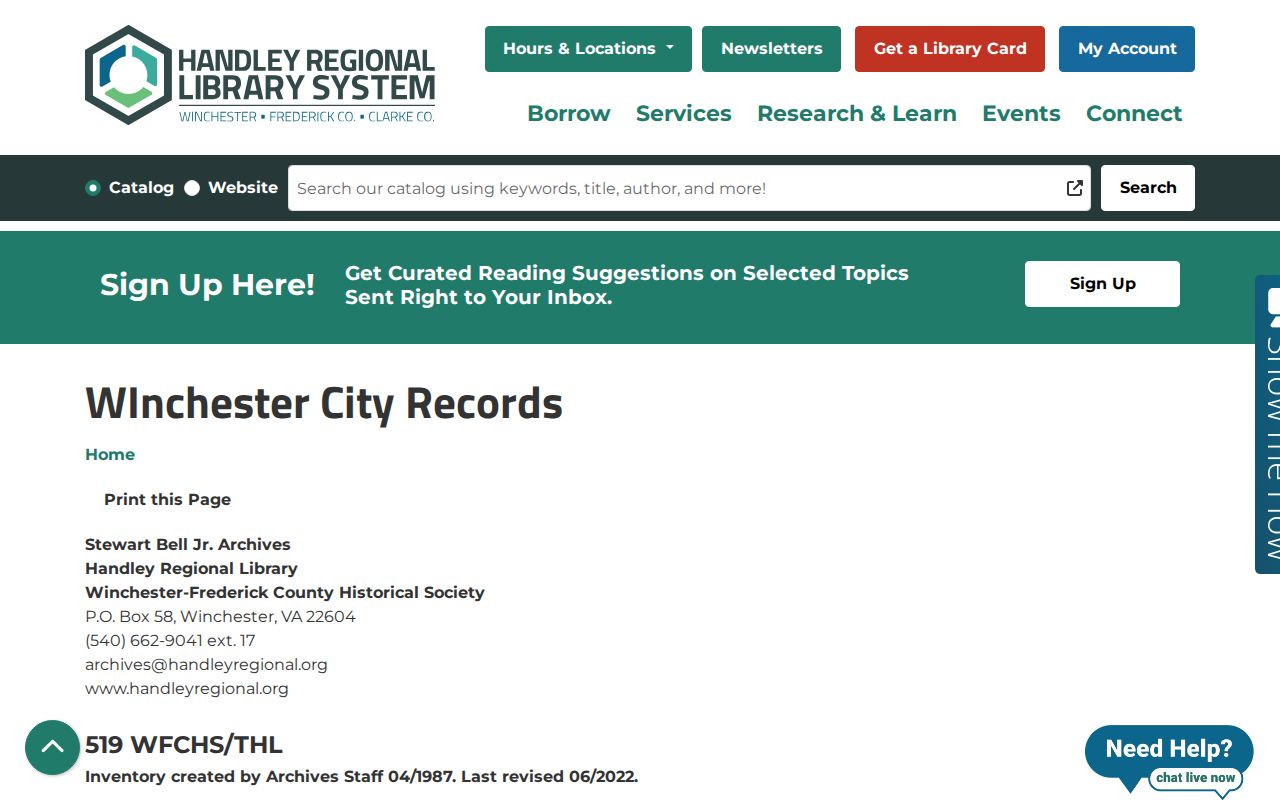
The finding aid points to selected years and record types, not a continuous online deed chain.
Library of Virginia Holds Older Reels
The Library of Virginia microfilm catalog for Winchester City lists vendor and vendee liens on reel 1. It also lists contracts from 1890 to 1902. Other reels hold city, administrative, and court material. Search by record category and date. Then ask whether the reel can be viewed locally. Ask about archival services or another access route too.
That reel can explain an old encumbrance or contract. It does not replace a modern deed search. Match each microfilm entry to the party names. Also match the property description and any later recorded release. For a title question, return to the Clerk's index and an official copy.
The Library of Virginia's Winchester catalog describes its microfilm holdings.
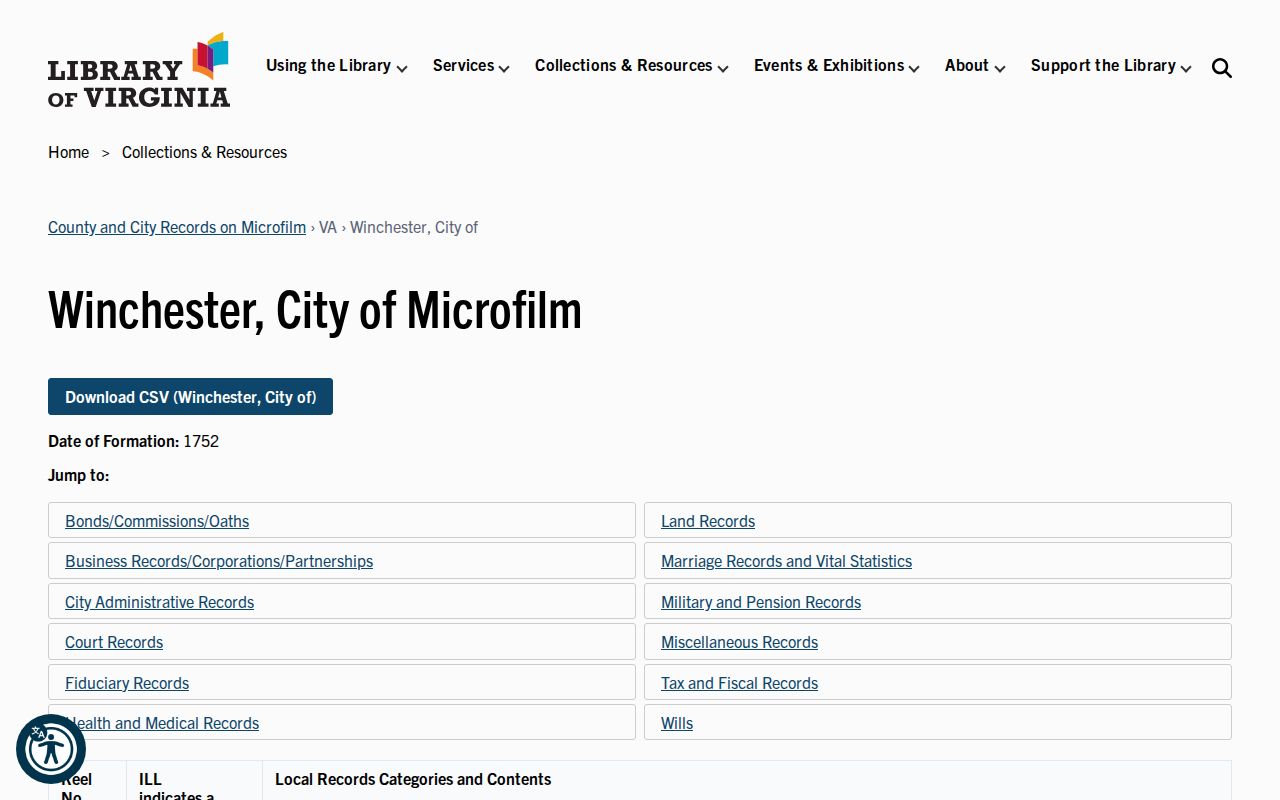
The catalog supplies reel leads when an online index stops short of an earlier record.
Winchester Tax Books Add a Time Slice
Handley's city and local tax books cover 1870 to 1910. The personal-property tax material from earlier periods is incomplete. A tax book shows a name in a given year. It can help locate a parcel or household clue. It is not a deed chain, though, and may not catch every transfer.
Record the year, the account or parcel clue, and any map or tract reference. Pair each entry with a later deed, a map, or an archive transfer record. Ownership may shift from a person to an estate or fiduciary. In that case, branch into probate rather than assuming a sale.
Annexation Can Change the Old Locality
Winchester's annexation files include material from 1905 and from 1970 to 1971. City sources describe the large later boundary change with 1971 or 1974 dates. A former owner's deed may call the land Frederick County. When it does, compare the historic legal description with the present city parcel and the annexation documents. Keep both labels in your title notes.
A postal name or modern street address will not always find a nineteenth-century grantee. Search old tract names, street variants, initials, married names, and both party roles. The deed's referenced prior instrument often supplies the strongest link. It can bridge one generation to the next.
Probate and Partition Split the Chain
An owner's death often sends a parcel down an unfamiliar path. Winchester City land records may show an executor or administrator deed, a deed of distribution, a fiduciary transfer, or a partition case. Check the Probate counter for the estate file. Then search the land index for the deed itself. The tax roll can lag here. It may still list the decedent or the estate until the City catches up. Foreclosures and quiet-title suits add their own paper. Pull the case file by number at the courthouse. Inside you might find a sale deed, a final decree, a release, or a partition instrument recorded in the deed records. A docket entry alone will not tell you what legally happened to the parcel.
Death Records Help Confirm a Person, Not a Transfer
A death record settles identity questions fast. It can separate two residents who shared a name. It can also pin down when an estate file likely opens. Virginia treats older vital records as public for genealogy. Recent ones carry eligibility and identification rules. Remember the limit. A death certificate is not a deed. It names no full list of heirs and explains nothing about how a parcel passed.
Take the date or identity clue into the Winchester probate file. From there, look for a fiduciary deed, a distribution, or a court order that touches the land. Only the recorded instrument ties an estate event to the parcel itself. Read it against its legal description. The Virginia Department of Health genealogy page describes public-period vital-record and microfilm access.
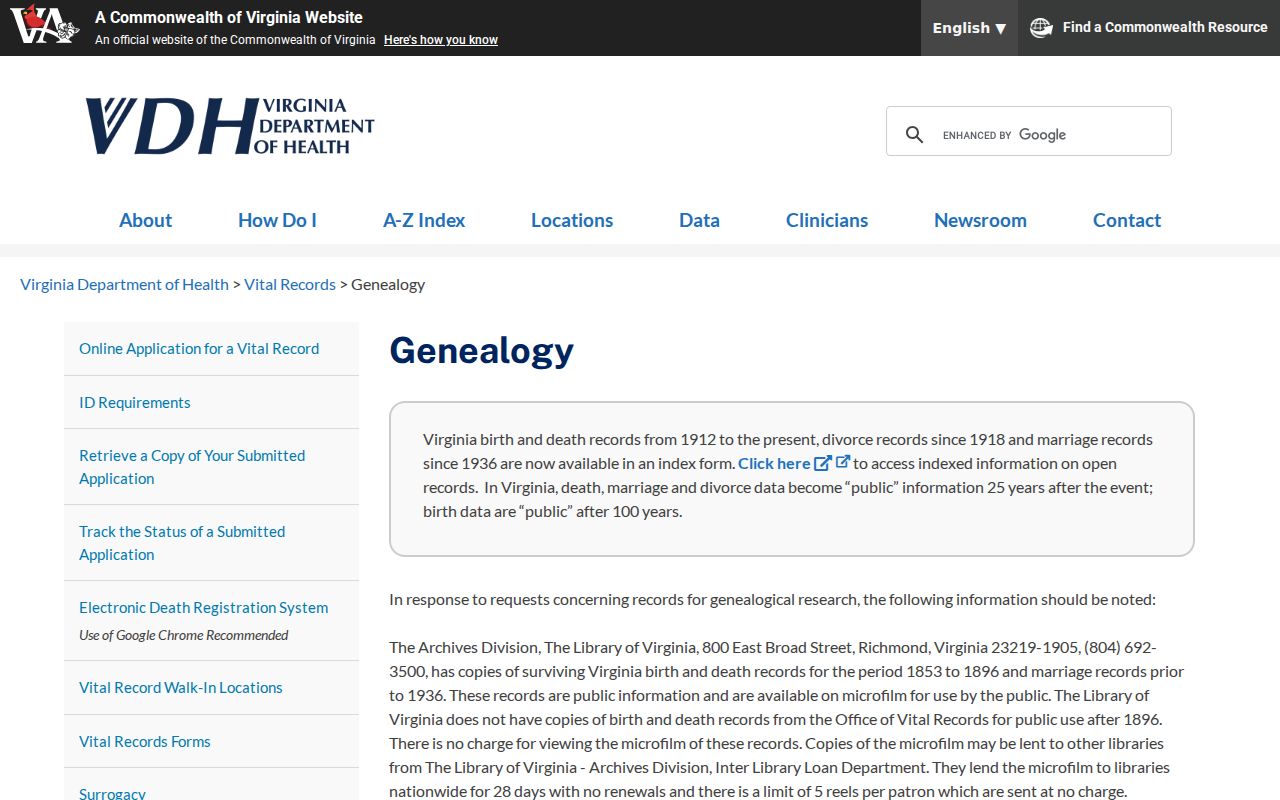
Hold the two threads apart: the vital record proves a person, while Winchester land records prove the transfer.
Newspapers and Directories Supply Leads
Handley's digitized newspapers cover the Winchester area from 1786 to 1925. A sale notice, an estate notice, or an obituary can add color to a deed date. So can a stray street reference. The archive also lists selected city directory material, including family listings spanning 1878 to 1922. It additionally holds a directory for 1987 to 1988. A complete annual run is not available.
Treat each newspaper hit as a lead, nothing more. Confirm ownership in the Clerk's recorded instruments. Old spelling, abbreviations, and street names often differ from modern forms. Note every variant you search, so a later researcher can retrace the path.
How Far Back Winchester Ownership Goes
How deep do Winchester City property records go? That depends on the instrument and the collection. The earliest deed year available online for Winchester is simply unknown. So treat any starting point as a discovery rather than a given. What does exist is a rich mix: city and court reels, old tax books, selected transfers, and other deed-related collections. The City itself was founded in 1744 and chartered in 1752. Those founding dates guarantee nothing about which land records from that era still survive.
For tracing an owner of record, start with the newest deed. Walk backward through the deed records until the index or book range runs out. When it does, ask the Clerk about older bound volumes. Handley Regional Library and the Library of Virginia catalog both cover earlier periods. Both cover other record classes as well. Copy the source's exact wording and year. Resist calling a partial archive a complete title chain.
Lawful use. Use former-owner research for house history, title work, estate matters, and purchase diligence. Do not use an owner's name or address to track, threaten, or harass a living person.